

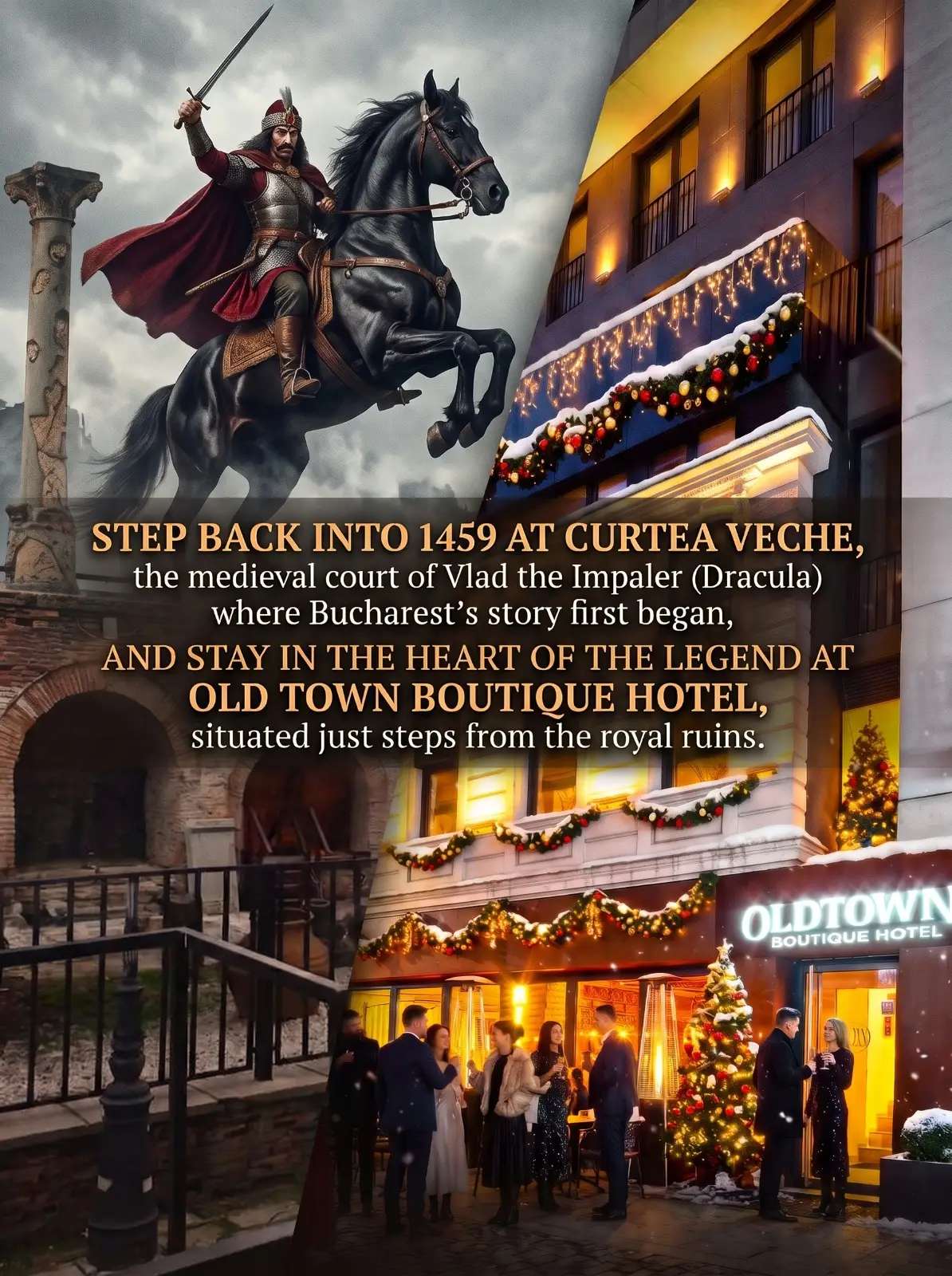
If you’re curious about the origins of Bucharest, the answer lies just a few steps away, in the heart of the city. The Old Princely Court Bucharest is the ensemble of ruins and museum that marks the site where the first princely palace of the capital was built, constructed during the reign of Vlad III Dracula in 1459. Few visitors realize that on this very narrow street in the Old Town, they are walking in the footsteps of one of the most controversial rulers in Romanian history.
Key Takeaways
- The Old Princely Court Bucharest is a medieval residence built in 1459, during the time of Vlad III Dracula, and today functions as a museum administered by the Bucharest Municipality Museum.
- The site was discovered through archaeological excavations that began in 1953 and displays original foundations of the princely palace. Here you can find ceramics and medieval artifacts.
- The bust of Vlad the Impaler created by sculptor Dumitru Pasima is located right in the museum courtyard and is one of the most photographed landmarks in the Old Town.
- The novel “The Rakes of the Old Court” by Mateiu Caragiale was directly inspired by the atmosphere of this neighborhood and brought the place into Romanian cultural consciousness.
- Staying near the Princely Court allows you to explore the most important historical landmarks in central Bucharest on foot.
By reading this guide, you will better understand the context in which the medieval palace was built and its historical importance. You will also learn how to organize a memorable visit to Bucharest’s Old Town.
History of the Old Princely Court: From Royal Palace to Archaeological Site
The Old Princely Court Palace was built in 1459, during the first reign of Vlad III Dracula, and served as the political and administrative center of Wallachia for over two centuries. The building was not erected all at once but grew and transformed under several successive rulers. Each added wings or rebuilt sections damaged by fires and earthquakes.
The palace functioned as the main residence of the rulers until the 17th century, when the capital began to expand and the administration gradually moved to other areas of the city. Abandonment came gradually, and the building deteriorated over the decades, leaving behind only foundations and fragments of walls.
Systematic archaeological excavations began in 1953 and brought to light the successive construction layers of the palace, confirming that the site went through multiple phases of expansion and reconstruction. Discoveries included medieval ceramics and coins. Household objects were also found, along with architectural fragments that document a period of nearly two hundred years of political continuity.
Today, the site is administered by the Bucharest Municipality Museum and is part of a broader effort to restore and enhance the historic center of the capital. The ruins are protected by a covered structure that allows visitors to descend and observe the foundation layers on site, without the risk of deterioration.
Its symbolic importance is hard to overestimate: for Bucharest, the Old Princely Court represents the birth certificate of the city as the political center of Wallachia. Every piece of brick displayed in the museum is direct testimony to how the modern capital came into being.
Vlad the Impaler and His Connection to the Old Princely Court in Bucharest
Vlad III Dracula, known to posterity as Vlad the Impaler, is the ruler most closely associated with the Old Princely Court in Bucharest, because he is the one who ordered the construction of the palace in 1459. Although he ruled in three distinct periods and did not spend his entire life in Bucharest, his court in the capital represented a real center of power in Wallachia.

Vlad the Impaler’s reputation oscillates between that of a severe but efficient leader and that of a cruel tyrant, depending on the source you consult. Romanian chronicles describe him as a defender of order and justice, who imposed strict laws and punished corruption. Saxon chronicles from Transylvania and German texts of the time constructed the dark image that later fueled the Dracula myth.
The bust of Vlad the Impaler located in the museum courtyard is the work of sculptor Dumitru Pasima and has become one of the most photographed spots in the Old Town. The serious expression and characteristic mustache make him immediately recognizable. The princely crown completes the portrait for anyone who has heard the story of Dracula at least once.
The Dracula Myth and Historical Reality
The confusion between Vlad the Impaler and the vampire Dracula created by Bram Stoker in 1897 is one of the most persistent misunderstandings related to Romanian history. Stoker borrowed the name “Dracula” and a few geographical details, but his literary character has no direct narrative connection to the Wallachian ruler.
Vlad III used the title “Dracula” as a reference to his father, Vlad II Dracul, a member of the Order of the Dragon. The word “dracul” in medieval Romanian meant both “dragon” and “devil,” which contributed to the aura of mystery surrounding the name.
Visitors who arrive at the Old Princely Court in Bucharest hoping for vampire legends may be surprised to discover instead a more complex and interesting story: a medieval ruler who tried to build a functioning state in an extremely unstable era. Ottoman threats loomed at the borders, while betrayals were constant within.
What You Can See at the Old Princely Court Museum
The Old Princely Court Museum in Bucharest offers you the opportunity to physically descend among the original foundations of the medieval palace, in covered spaces that protect the archaeological layers. Access is through a modest entrance on Iuliu Maniu Street, and the admission fee is low compared to the experience it offers.
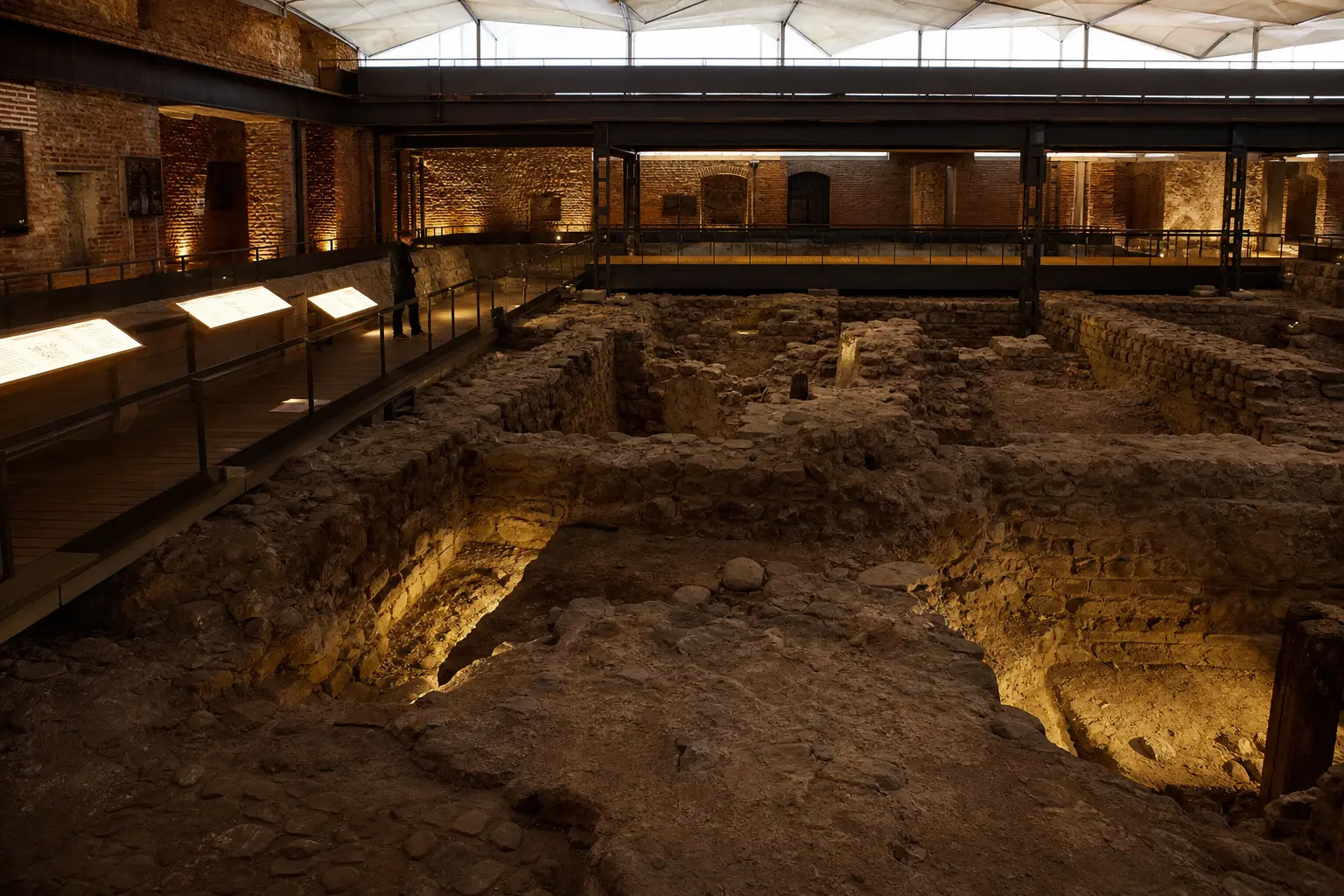
The permanent exhibition includes medieval ceramic fragments and coins discovered during the excavations. Informational panels explain the succession of construction phases of the palace and are available in Romanian and English, making the visit accessible to foreign tourists as well.
The Bust of Vlad the Impaler and the Outdoor Courtyard
The outdoor courtyard of the museum is an open space where the bust of Vlad the Impaler created by Dumitru Pasima is located. The area around the bust is often animated by tourists photographing the monument or listening to guides telling episodes from the ruler’s life.
Near the museum is also the Saint Anthony Church, one of the oldest churches in Bucharest, which is part of the same historical ensemble. Entry to the church is free, and the interior preserves painting and architectural elements specific to the post-medieval period.
Visiting Hours and Practical Tips
The museum is open from Tuesday to Sunday, and Monday is a rest day. Visiting in the morning is recommended, when tourist groups are rarer and you can study the exhibits in peace. Specialized guides can be booked in advance for a more detailed experience.
Photography inside is allowed without flash, and the space is not very large, so a complete visit takes between 45 minutes and an hour. If you combine the visit with a walk through the Old Town, reserve at least half a day for the entire area.
Cultural Impact: From Mateiu Caragiale to Today’s Old Town
The Old Princely Court in Bucharest is not just an archaeological site; it is a place that has inspired literature, urban architecture, and cultural identity. The most direct example is the novel “The Rakes of the Old Court” by Mateiu Caragiale, published in 1929, which describes a world of decadent and reveling boyars in the neighborhood around the former palace.
Caragiale’s novel fixed in the Romanian cultural imagination the idea that the area around the Old Princely Court is a space of extremes: brilliance and decadence, history and vice. This duality can still be felt today in the Old Town, where historic buildings stand alongside bars and restaurants.
Efforts to restore Bucharest’s historic center have placed the Old Princely Court at the heart of urban regeneration projects. Lipscani Street and adjacent streets have been paved and returned to pedestrian traffic, and surrounding buildings have received funding for rehabilitation.
The Old Town as a Contemporary Cultural Destination
Today, Bucharest’s Old Town attracts visitors eager for history, but also young people interested in nightlife and gastronomy. This overlap of functions makes the area an atypical place: you can enter a medieval museum in the morning and dine at a restaurant with a view of the same ruins in the evening.
Art galleries and independent cafes have settled into buildings with neoclassical or Art Nouveau facades. Design shops complete the landscape, creating a visual contrast that is, in itself, a lesson in urban history. The layers of time are visible on every street corner.
Periodic cultural events, including medieval fairs and street performances, bring the period atmosphere back to life near the Old Princely Court and transform the visit into more than a static experience.
How to Plan Your Visit to the Old Princely Court and What Else to Explore Nearby
A well-organized visit to the Old Princely Court in Bucharest requires a few hours dedicated to the Old Town as a whole, not just the museum itself. The site is located on Iuliu Maniu Street, near Unirii Square and Brătianu Boulevard, so it is easily accessible by metro or on foot from any central point of the city.
The recommended route for half a day includes entering the museum and visiting the ruins with the bust of Vlad the Impaler. Continue with a short stop at Saint Anthony Church, then take a walk on Lipscani Street to St. George Square. Along the way, you will pass buildings with their own stories and places where you can take a coffee break.
Historical Landmarks Near the Old Princely Court
| Landmark | Distance from the Old Princely Court | Estimated Visiting Time |
|---|---|---|
| Saint Anthony Church | 50 meters | 15–20 minutes |
| Lipscani Street | 100 meters | 30–45 minutes |
| Unirii Square | 400 meters | 20 minutes |
| Manuc’s Inn | 150 meters | 20–30 minutes |
| CEC Palace | 500 meters | 15 minutes (exterior) |
If you have children with you, some museums in the area organize educational workshops with medieval themes, where little ones can learn details about life at a ruler’s court. Check the schedule before your visit, as these activities have limited spots.

Public transportation is the most practical option for reaching the Old Town, as parking is limited and expensive in the area. The Unirii metro station is a few minutes’ walk from the museum, and several bus lines stop in the immediate vicinity.
Accommodation in the Old Town: How to Choose the Ideal Place to Discover History
Choosing accommodation in the immediate vicinity of the Old Town completely transforms the visitor experience: you can reach the Old Princely Court in Bucharest in a few minutes on foot, early in the morning, before tourist groups occupy the space. This flexibility is one of the greatest advantages of a well-positioned hotel in the area.
If you want to explore the Old Town without worrying about transportation or parking, a convenient option is to look for accommodation in Bucharest’s Old Town that puts the main attractions within walking distance. This choice leaves you more time for visits and less time lost in traffic.
A hotel positioned in the old center of the capital allows you to return to your room anytime for a break. You can go out in the evening to explore the atmosphere after sunset and start each day directly from the heart of history. There is no substitute for the comfort of staying a few hundred meters from the landmark you want to explore.
What to Check When Booking Accommodation Near the Old Princely Court
The distance from the landmarks you want to visit is the first criterion to select. Check on the map whether the hotel is within the pedestrian perimeter of the Old Town or if it requires additional transportation.
Another important aspect is nighttime noise, as the Old Town area has an active nightlife. Rooms facing inner courtyards or secondary streets offer a more peaceful sleep than those exposed to main arteries.
You can find more details about available options and offered amenities on the hotel Bucharest Old Town page, where you can compare rooms and check availability for your travel dates. Advance booking is recommended in the summer season, when demand in the Old Town is high.
Breakfast included in the rate is a significant advantage when exploring a large area on foot: you start well-fed and don’t have to search for a place first thing in the morning, when many cafes in the Old Town are still closed or crowded.
If you are interested in special rates or offers for longer stays, also check the vouchers and special offers page available on the site, where you can find discounts adapted to different types of visitors.
Frequently Asked Questions About the Old Princely Court in Bucharest
How much does admission to the Old Princely Court in Bucharest cost?
The admission fee to the Old Princely Court Museum in Bucharest is modest and varies depending on the visitor category: adult, child, pensioner, or student. It is recommended to check the updated fee directly at the museum ticket office or on the Bucharest Municipality Museum website, as prices may be adjusted periodically.
Is it worth visiting the Old Princely Court if I only have a few hours in Bucharest?
Yes. The museum is compact and a complete visit takes between 45 minutes and an hour, making it ideal for a tight itinerary. Combined with a walk on Lipscani Street and a short stop at Saint Anthony Church, you can cover the historical essence of the Old Town in two to three hours.
Is there a real connection between Vlad the Impaler and the vampire Dracula from novels?
The connection is only partial and rather nominal in nature. Bram Stoker borrowed the name “Dracula” and a few geographical elements for his 1897 novel, but the vampire character is a literary creation without a direct basis in the biography of the Wallachian ruler. Vlad the Impaler was a real medieval leader, not a fantasy character.
Can I visit the Old Princely Court with small children?
Yes, the museum is accessible to families with children. The space is not very large, and the informational panels explain the history in an accessible way. Some educational programs for children are organized periodically, but must be booked in advance. The outdoor courtyard with the bust of Vlad the Impaler is also attractive to little ones.
Is the Old Princely Court in Bucharest open all year?
The museum operates from Tuesday to Sunday and is closed on Monday. Visiting hours may vary depending on the season or legal holidays, so advance verification is recommended. During Christmas or Easter periods, the schedule may be modified.
If you want more information about how to organize your stay in Bucharest’s Old Town or want to find out what accommodation options are available near the Old Princely Court, contact us and we will be happy to answer any questions.
To discover other tourist attractions in Bucharest’s Old Town, consult our complete guide that includes all points of interest in the area.

