

Key Takeaways
- Christmas traditions in Romania combine Orthodox Christian customs with folk practices hundreds of years old, varying significantly from one region to another.
- The Christmas fast lasts six weeks and ends on the night of December 25th, spiritually preparing believers for the celebration.
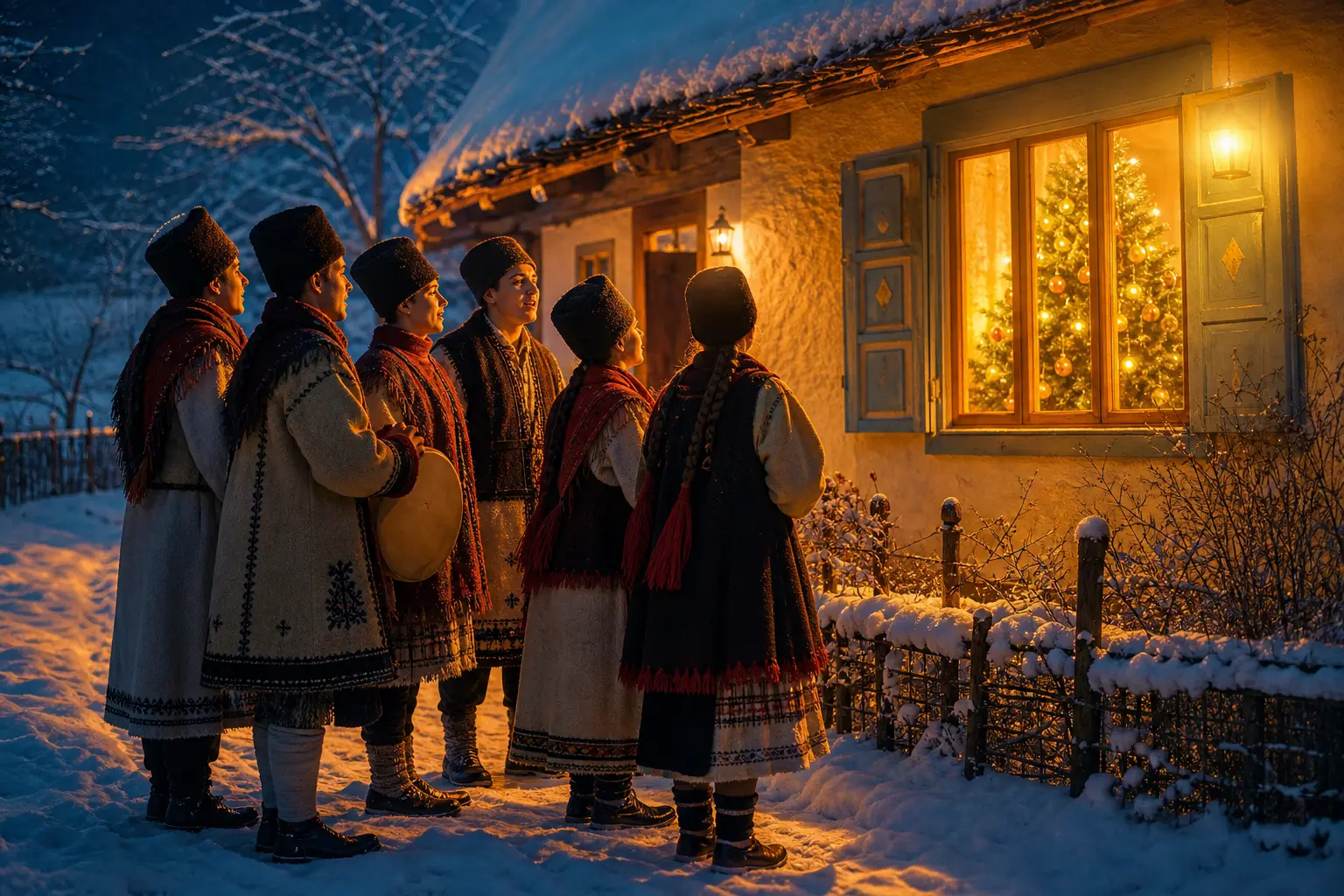
- Caroling is the central custom of Romanian Christmas: both children and adults go from house to house singing carols and receiving traditional bread or money.
- Decorating the Christmas tree is usually done on Christmas Eve, with ornaments, tinsel, and traditional sweets.
- Each historical region of Romania, from Maramureș to Oltenia, preserves specific rituals that make the celebration unique.
This guide helps you understand each stage of the Romanian winter holidays, from the six-week fast to the final days of the ritual period. You will discover what makes each tradition special.
The Christmas Fast and Traditional Preparations
Romanian Christmas does not begin on December 25th. It starts much earlier, with the beginning of the Christmas fast, a six-week period of culinary and spiritual abstinence that ends on the night of the Nativity. This preparatory period is an integral part of Christmas traditions in Romania and gives the holidays a depth that the commercial calendar does not capture.
In rural communities, fasting means giving up meat and dairy, but also public entertainment. Believers attend evening services more frequently and dedicate themselves to prayer. This spiritual dimension is what gives meaning to the joy of Christmas Day.
Practical preparations go hand in hand with spiritual ones. In Romanian villages, men tidy up the yard and clean the stables, a gesture that symbolizes purification before the celebration. Women, in turn, clean the house from top to bottom, scrub the wood, and prepare the doughs.
These activities are not simple household chores. They have a ritual logic: a clean house receives the grace of the celebration, and well-cared-for animals reflect respect for nature and for the birthplace of Jesus, a cave with animals. This symbolic connection between caring for animals and the Nativity is specifically Romanian.
Culinary preparations also begin early. Women prepare cozonac (sweet bread) and colaci (traditional bread), along with other treats that are not eaten during the fast but are baked beforehand to be ready for Christmas Eve. The smell of fresh cozonac from the oven is, for many Romanians, the most direct signal that Christmas is near.
Also during this period, young people in villages begin to organize for caroling. They rehearse the carols and prepare the costumes. The routes for Christmas Eve night are carefully planned. Preparing for caroling is itself a social ritual, a moment when the community comes together around the celebration.
Decorating the Christmas Tree: Symbols and Customs
The Christmas tree is present in every Romanian home, but the way it is decorated and the moment chosen for this ritual differs from family to family. The most widespread custom is to decorate the tree on Christmas Eve, December 24th, both indoors and in the yard.
Colored ornaments and silver tinsel are the classic decorations of the Romanian Christmas tree, along with chocolate candies popularly called “saloane.” Each element has its own logic: the ornaments represent fruits, the tinsel imitates rain or snow, and the sweets are a symbolic gift for children.
The star at the top of the tree is an element with direct religious significance. It recalls the Star of Bethlehem, the most important symbol of the Nativity. In some families, the star is replaced with an angel, another central biblical symbol for this celebration.
In villages, the tree was often cut from the forest by family members themselves, a gesture that involved going out into nature and making a careful choice. This practice has been partially preserved in mountainous areas. In cities, the natural or artificial tree is bought from Christmas markets, which appear in all major cities starting in November.
Decorating the tree is a quintessential family moment. Children hang the ornaments, parents arrange the lights, and grandparents tell stories about how the tree was decorated in their childhood. This informal transmission of traditions is exactly the mechanism by which customs survive from one generation to the next.
Gifts are placed under the tree, usually on the night of December 24th to 25th. Children believe that Santa Claus brings them during the night, and Christmas morning means the excited unwrapping of packages. This sequence reproduces, in secular form, the religious structure of the celebration: waiting, then joy.
Caroling, the Central Custom of Christmas Traditions in Romania
Of all winter traditions, caroling is the oldest and best preserved. Groups of children and groups of adults gather and go from house to house singing carols, wishing the hosts health and prosperity. Caroling is not a simple folk custom; it is a community act with pre-Christian roots, later reinterpreted in a Christian religious key.
Romanian carols are extremely varied. Some narrate episodes from the Nativity, others describe the nature of winter or wish the hosts abundant harvests. The melody “O ce veste minunată” (What Wonderful News) is one of the best known, sung in all regions of the country. “O brad frumos” (O Beautiful Tree) is another song found in the repertoire of all caroling groups.
Hosts who receive carolers have a moral obligation to reward them. Carolers receive homemade colaci or money. Refusing to open the door to carolers was considered in the past a bad sign, an attitude that brought misfortune upon the house. This logic of reciprocal gift-giving is essential for understanding caroling.
Adults who carol form organized groups, with a leader called “vătaf.” They prepare for weeks, rehearsing the carols and establishing the order of houses they will visit. In some villages, adult carolers visit only houses with marriageable daughters, a practice that linked caroling to the social customs of the community.
Children set out to carol on the morning of December 25th or even on Christmas Eve. They go to relatives and neighbors, reciting short carols or wishes in verse. Their reward comes in the form of sweets or small sums of money, and the joy of this ritual remains for many of them one of the most vivid memories of childhood.
Christmas Eve: Rituals and Traditional Food
December 24th concentrates the densest ritual moments of the celebration. Christmas Eve is the day when the tree is decorated, the last day of fasting ends, and the evening meal is prepared. It is a day of transition between waiting and the actual celebration.
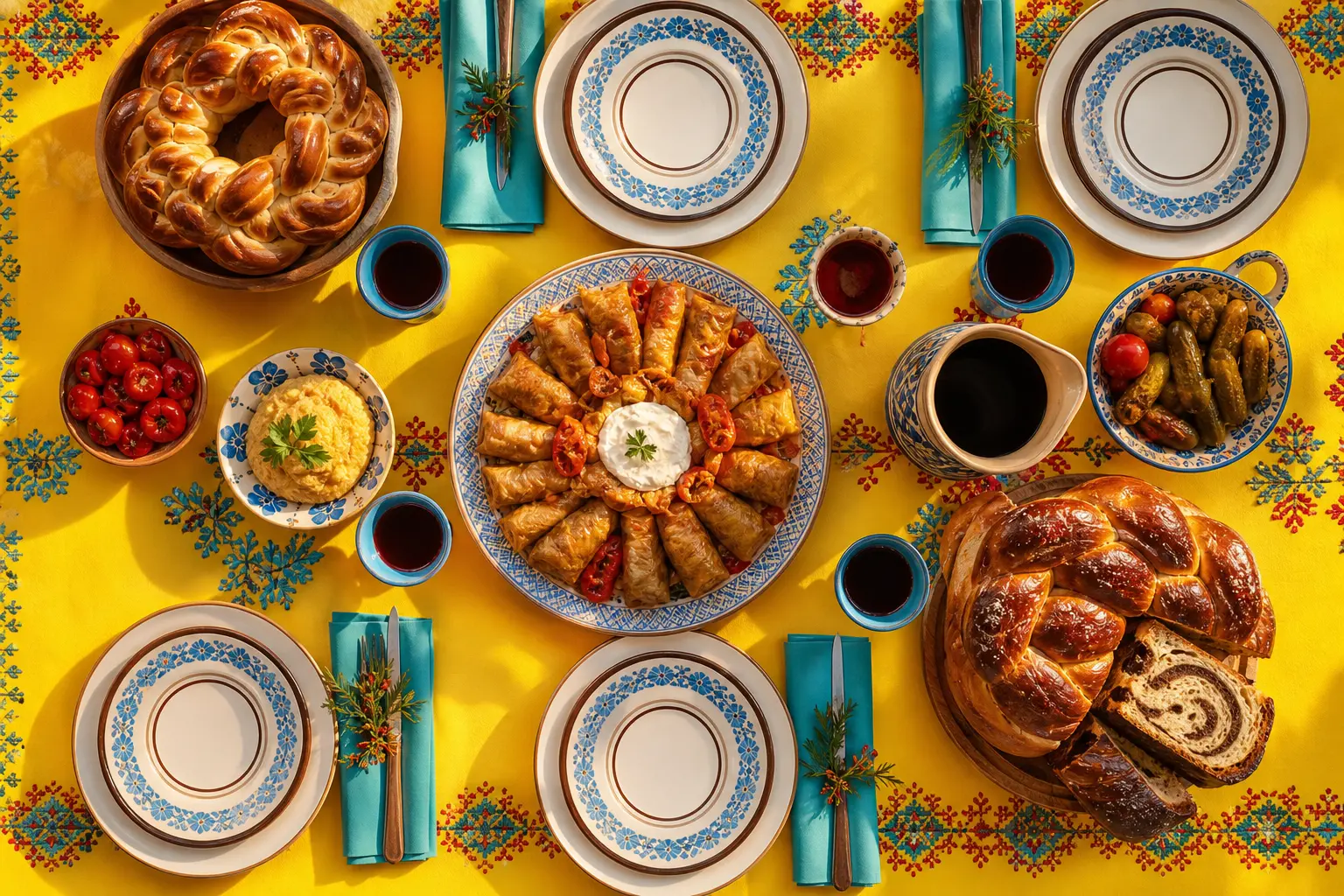
The Christmas Eve meal has its own rules. In many families, twelve fasting dishes are served, one for each apostle. Boiled wheat with honey and fried fish are present on traditional tables. Fasting cabbage rolls with rice and mushrooms complete the menu. This frugal, fasting meal deliberately contrasts with the abundance of Christmas Day.
In some areas, especially in Moldova and Bucovina, the Christmas Eve meal includes a special ritual related to bread. The host breaks the Christmas colac and shares it with family members, a gesture reminiscent of the Eucharist. The colac is baked in a round shape or braided, with a red egg in the middle in some local traditions.
Christmas Eve night is when adult carolers set out on the streets. The sound of bells and drums from the columns of carolers fills the air of villages, along with traditional flutes. This sonic image of Christmas Eve is inseparable from the feeling of Christmas for anyone who grew up in rural Romania.
The big Christmas meal comes on December 25th and is the opposite of the Christmas Eve meal. Cabbage rolls with pork and toba (blood sausage) are the main dishes. Caltaboși (liver sausage) and homemade sausages complete the selection of pork preparations. Cozonac with walnuts or poppy seeds, along with homemade pastries, conclude a feast that can last for hours. Wine and țuică (plum brandy) complete the picture.
If you visit Bucharest during this period, the atmosphere of the city changes completely. Christmas markets and lights everywhere transform the center of the capital, and the smell of mulled wine floats in the air. Accommodation in Bucharest’s Old Town gives you direct access to all these festive atmospheres.
Regional Christmas Traditions: From Maramureș to Oltenia
Romania does not have a uniform Christmas. Each historical region has developed its own variants of the celebration, influenced by terrain and cultural neighbors. Local history has also left distinct marks. Understanding these regional differences is essential for anyone who wants to truly know Christmas traditions in Romania.
In Maramureș, Christmas is dominated by fiddlers and their songs. Maramureș caroling is one of the most spectacular in the country: men dressed in traditional costumes go in large groups, playing the violin and other instruments. The melodies from this area have an archaic character, with inflections reminiscent of medieval music.
Bucovina has its own Christmas identity, centered on the Christmas Eve Dinner and bread-related customs. Here, Christmas colaci are true works of folk art, shaped into forms of animals or stars. The monasteries of Bucovina organize night services attended by hundreds of believers from all over the country.
In Transylvania, a distinct custom is Viflaimul, a kind of folk theater that recreates the scene of the Nativity. Young people from the village play the biblical characters and go with this play from house to house. The masked play, also present in Transylvania, adds a carnival element that coexists with the religious dimension.
Oltenia is the area where the Star custom is best preserved. Groups of children and young people carry a large star, lit from inside, which they turn and rotate while singing carols about the Star of Bethlehem. The star is decorated with religious images and bells that ring rhythmically with each movement.
These regional differences are not simple folkloric curiosities. They show that Romanian identity is plural and that tradition has never been a uniform block. The same religious calendar has produced distinct rituals depending on community and geography.
| Region | Specific Custom | Distinctive Element |
|---|---|---|
| Maramureș | Caroling with fiddlers | Live music with traditional instruments |
| Bucovina | Christmas Eve Dinner | Sculpted colaci and monastery services |
| Transylvania | Viflaimul and masked play | Folk theater with biblical characters |
| Oltenia | The Star | Illuminated star carried by carolers |
The Twelve Days of Celebration and Their Significance
Romanian Christmas does not end on December 25th. The official celebration includes December 25th, 26th, and 27th, but folk tradition extends the ritual period to twelve days, from Christmas Eve to Epiphany, on January 6th. This twelve-day period has its own logic and a set of specific prohibitions and customs.
The three days of Christmas proper (December 25th, 26th, and 27th) are days of rest and family visits. No work is done and no clothes are washed. Heavy chores are forbidden. These prohibitions are older than Christianity and reflect a respect for sacred time that the Christian calendar adopted and reinterpreted.
Visits to relatives are obligatory during these days. Extended families gather at the table, children show off the gifts they received, and elders tell stories of traditions from the past. This intense social mobility during the Christmas days is a driver of community cohesion.
On December 27th, Orthodox Christians celebrate Saint Stephen. Those who bear this name receive visits and wishes, and their families organize festive meals. This day adds an additional layer of celebration to the winter period.
Romanians of Slavic origin or of the old rite celebrate Christmas on January 7th, according to the Julian calendar. In some communities in the north of the country, the two Christmases coexist, and mixed families celebrate twice. This phenomenon illustrates the internal diversity of Romanian traditions.
The twelve-day period ends with Epiphany and Saint John’s Day, on January 7th. The blessing of water at Epiphany is a major winter ritual that completes the cycle begun at Christmas. Priests come to the homes of believers to bless the dwellings with holy water, a gesture of purification and protection for the new year.
If you want to experience these traditions firsthand, Bucharest offers public events and carol concerts during this period. Christmas markets complete the festive atmosphere. A hotel in Bucharest’s Old Town provides you with an ideal base to explore the city during the holiday season. You can learn more about places to visit in winter in Bucharest’s Old Town to plan your visit.
Frequently Asked Questions About Christmas Traditions
When is the Christmas tree decorated in Romania?
The most widespread custom is to decorate the tree on Christmas Eve, December 24th. Some families choose to do it earlier, especially if they have small children, but the classic tradition links decorating the tree to the 24th.
How long does the fast before Christmas last?
The Christmas fast lasts six weeks and ends on the night of December 25th. During this period, Orthodox believers give up meat and dairy and attend religious services more frequently.
What do carolers receive from hosts?
Carolers usually receive homemade colaci or money. In some areas, they are also offered sweets or fruit. Refusing to reward carolers was considered in the past a sign of disregard for tradition and brought misfortune upon the house.
What is the oldest Christmas custom in Romania?
Caroling is considered the oldest Christmas custom in Romania, with pre-Christian roots. It was adopted and reinterpreted by Christianity, but its structure of collective wishing and reciprocal gift-giving predates the Christian calendar.
Is Christmas celebrated on January 7th in Romania?
Yes, Romanians of Slavic origin or who follow the Julian calendar celebrate Christmas on January 7th. In some communities in the north of the country, both dates are celebrated, and mixed families may organize two separate festive meals.
Romanian Christmas traditions are an experience best lived firsthand. Contact us through the contact us page to find out how you can spend the winter holidays in the heart of Bucharest. Also discover tourist attractions in Bucharest’s Old Town for a complete experience.

