Key Takeaways
- Bucharest’s Old Town has a history spanning over five centuries, beginning with the medieval princely court built in the 15th century.
- Lipscani Street was the commercial heart of the city, connecting guilds and inns in a single economic district. Printing houses completed this network.
- Monuments such as Manuc’s Inn and Stavropoleos Church have survived all of Bucharest’s major urban transformations.
- After 1989, the area entered a deep decline, followed by a rehabilitation process that accelerated in the early 2000s.
- Today, Bucharest’s Old Town is an active cultural space, with restaurants and galleries attracting tourists from all over Europe. Cultural events complement this offering.
By reading this article, you will understand how Bucharest’s oldest neighborhood was formed and transformed over the centuries. We will journey from the first medieval constructions to today’s restaurants and galleries.
Medieval origins and the princely court
It all began with a wooden fortress built on the banks of the Dâmbovița River in the 15th century. Voivode Vlad II Dracul used this area as a campaign residence. Later, his son Vlad the Impaler continued the tradition, and gradually it gained political and economic importance. The Old Princely Court, as it is known today, became the nucleus from which the entire city developed.
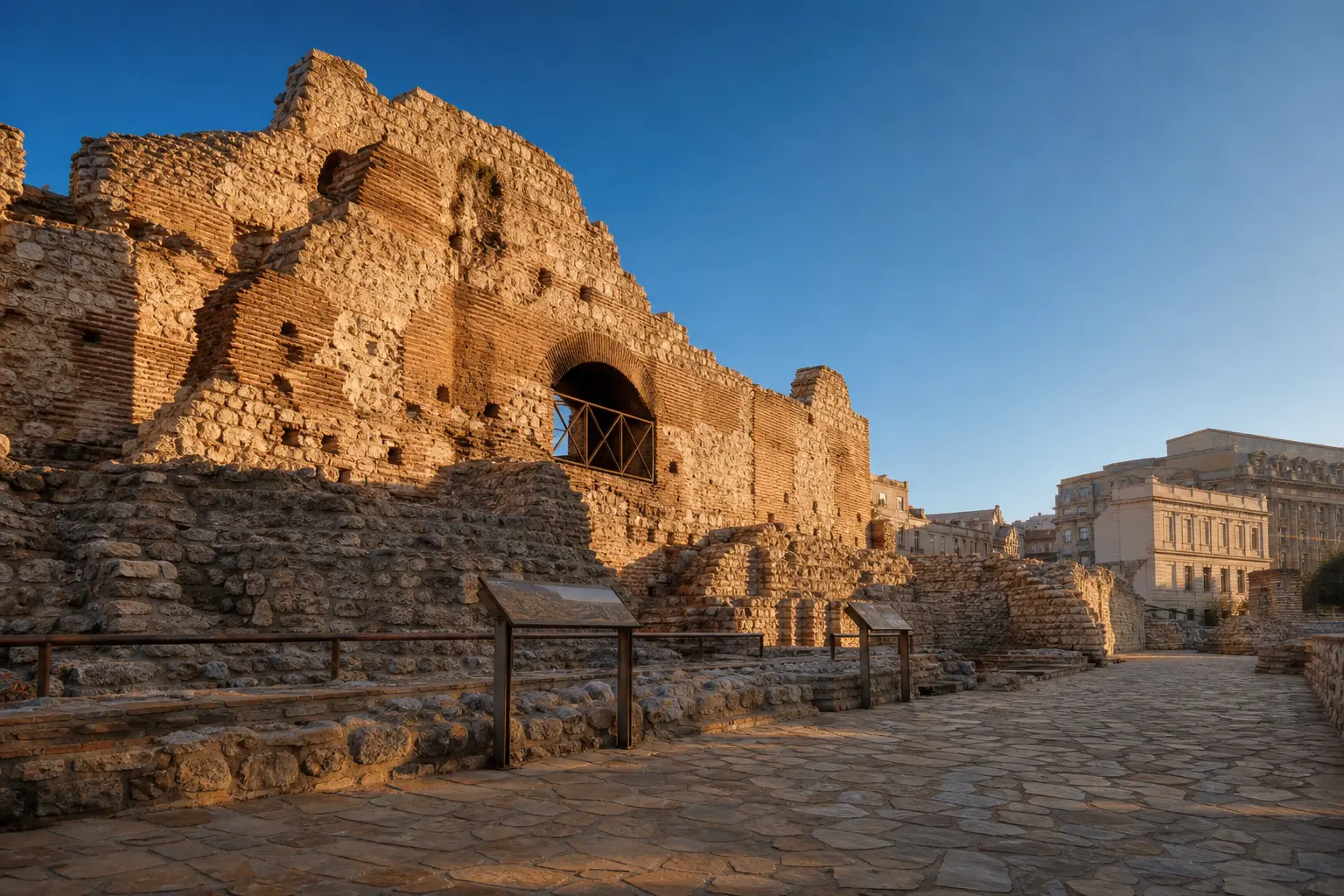
The ruins of the Old Princely Court, still visible on Franceză Street, date from the 15th century and represent the oldest architectural structure in Bucharest. Rulers such as Mircea the Shepherd and Petru the Lame lived and governed here, transforming the area into an administrative and diplomatic center of Wallachia.
The princely court was not just a residence. Around it rose craftsmen’s workshops and boyars’ dwellings. The first inns for merchants coming from the Ottoman Empire and the Balkans completed the ensemble. This concentric structure, with the palace at the center and economic activity around it, defined the urban pattern of the area for centuries.
Repeated fires in the 17th and 18th centuries destroyed much of the wooden constructions, but the stone walls of the court remained. Each fire was followed by reconstruction, and each time the neighborhood grew a little larger and a little more solid. This resilience in the face of adversity is the most constant trait of the capital’s historic area.
Archaeological excavations conducted in the second half of the 20th century unearthed ceramics and coins. The wall fragments discovered confirm continuous occupation of the site since medieval times. These discoveries have transformed the Old Princely Court into an archaeological site open to the public, where history can literally be touched.
Lipscani: the commercial heart of the old city
Lipscani Street took its name from merchants from Leipzig, called “lipscani” by Bucharest residents in the 18th century. They brought expensive goods from the West and sold them in the shops lined along this artery, which quickly became the symbol of organized commerce in the capital. Gradually, the name “Lipscani” came to designate the entire commercial district around it.
During the area’s golden period, Lipscani brought together the guilds of bootmakers and silversmiths with transit inns. Printing houses producing books and official documents operated in the same perimeter. It was a space where money and ideas circulated simultaneously with goods, and the rhythm of commercial life did not stop at sunset.
The inns played a decisive role in the neighborhood’s economic structure. They functioned simultaneously as warehouses and covered markets. Transit merchants also found lodging here. Some inns also served as unofficial currency exchanges, given that coins from the Ottoman Empire and Austria circulated at the same time on the same stalls, alongside those from the Romanian principalities.
Besides commerce, the Lipscani area also hosted the first printing houses in Bucharest. Greek and Romanian printers produced religious books and administrative texts here, contributing to literacy and the circulation of information in the Romanian space. This cultural dimension of the neighborhood is often forgotten in favor of its commercial image.
If you want to explore the area and need accommodation in Bucharest’s Old Town, you will find yourself just a few minutes’ walk from all these historically significant places.
Famous monuments that have withstood time
Of all the buildings that have survived in the capital’s historic area, two stand out for their age and their story: Manuc’s Inn and Stavropoleos Church. Each represents a different layer of the neighborhood’s history.
Manuc’s Inn: Bucharest’s Armenian caravanserai
Built in 1808 by Emanuel Mrzaian, known as Manuc Bey, a wealthy Armenian merchant and diplomat from the Ottoman Empire, Manuc’s Inn was designed as a large-scale caravanserai. Manuc Bey wanted a space where travelers could rest and conduct business under the same roof. They could also socialize freely here. At its peak, the inn hosted merchants from all over the Balkans and the Middle East, alongside Romanian boyars and political emissaries.
The building features architecture characteristic of late Ottoman inns, with wooden galleries on multiple levels and a wide inner courtyard. This form allowed for the supervision of stored goods and the separation of sleeping quarters from commercial spaces. Today, the restored building houses a hotel and restaurant, preserving its original function as a place of hospitality.
Stavropoleos Church: the Brâncovenesc jewel of the neighborhood
Founded in 1724 by Ioanichie Stratonikeas, a Greek monk from Epirus, Stavropoleos Church was originally part of a monastic complex connected to an inn. Its name comes from the Greek Stauropolis, meaning “City of the Cross.” The original inn no longer exists, but the church and fragments of the initial complex have survived.
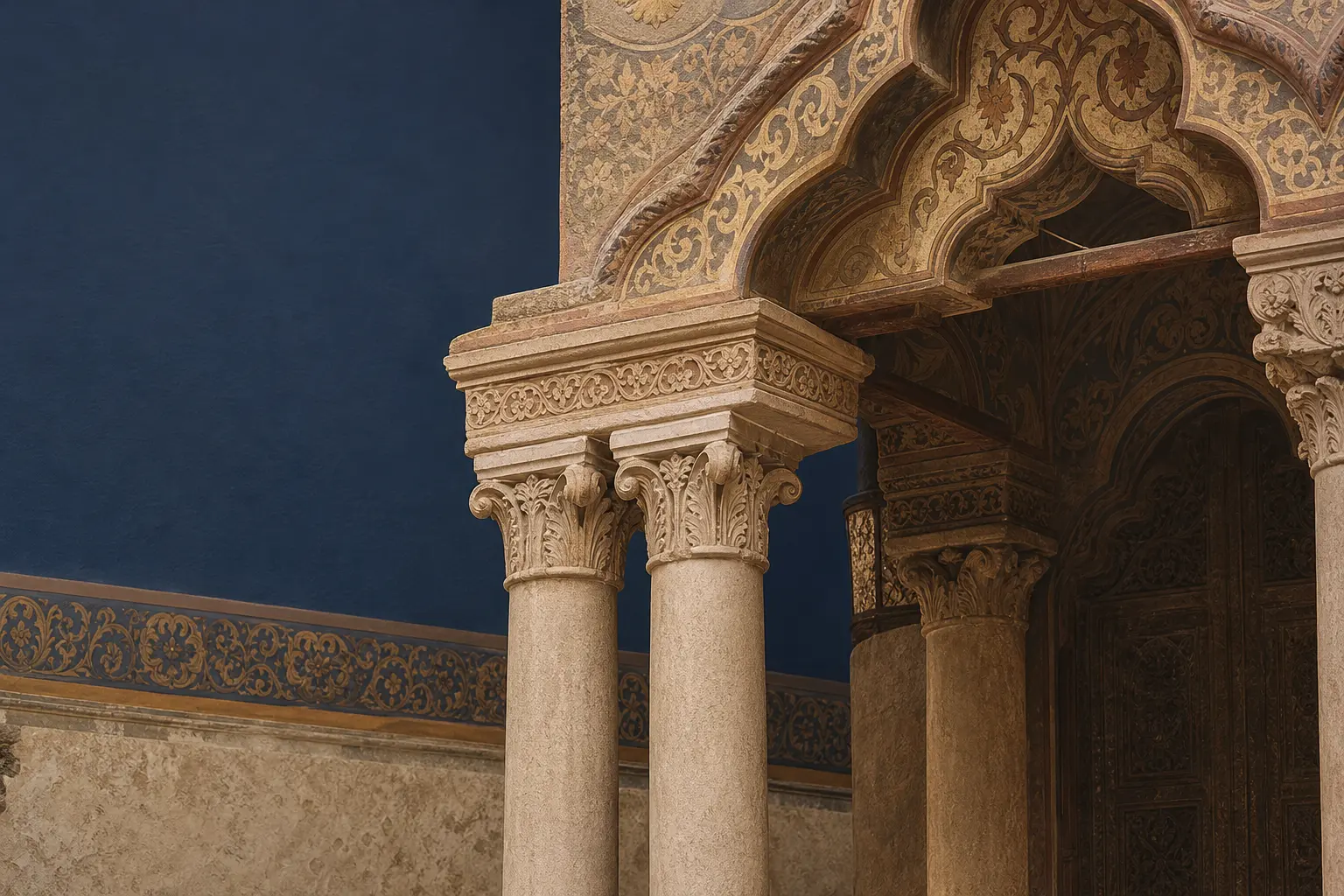
The Stavropoleos façade is a refined example of Brâncovenesc art, with sculpted columns and floral motifs that demonstrate the high level of craftsmanship of the era. The inner courtyard houses funerary stones and architectural fragments collected from other churches demolished over time. The place has thus transformed into a small open-air museum.
Modern transformations and neighborhood rehabilitation
The fall of communism in 1989 left Bucharest’s Old Town in a profound state of decay. Decades of administrative neglect and lack of private investment had transformed many historic buildings into inhabited or abandoned ruins. It was an area that, on the surface, seemed to have no future.
The transformation began timidly in the early 2000s, when private entrepreneurs discovered the area’s tourism potential. The first cafés and restaurants opened in renovated buildings attracted a young audience, and their success convinced other investors to follow the same model. The process was neither uniform nor free of controversies regarding the quality of renovations.
Local authorities declared the area protected and imposed rules for façade interventions. This decision slowed some projects but also prevented demolitions or brutal modifications that would have destroyed the historic character of the streets. The balance between protection and development remained a constant tension throughout this period.
The pedestrianization of several arteries, including the main boulevard in the area, radically changed the relationship between public space and historic buildings. Without cars, façades become fully visible, and walking among them transforms from an exercise in avoiding traffic into an architectural experience. This urban planning decision significantly contributed to the increase in visitor numbers.
The rehabilitation process continues today. Some buildings are still under construction, while others have already been completely restored. A few of them await funding. This intermediate stage gives the neighborhood a particular energy: it is not a museum frozen in time, but an urban organism in active transformation.
The history of Bucharest’s Old Town told through its streets
Each street in the capital’s old neighborhood has its own origin and a name with its own story. By reading these names, you can reconstruct the successive layers of Bucharest’s urban history, from Ottoman domination to French influence and the interwar period.
Franceză Street, for example, bears this name because the French consul to Bucharest lived there at one point. It is not a street that was exclusively inhabited by French people, but one that received this name following a specific diplomatic presence. The successive name changes of some arteries reflect each political regime that passed through the city.
Șelari Street and Blănari Street name guilds that once operated exactly there. Covaci Street bears the name of the neighborhood’s blacksmiths, while the șelari made saddles for horses, and the blănari worked furs. This craftsmen’s geography shows that the medieval city was not organized randomly, but according to a strict economic logic.
Some streets changed their names multiple times in the 20th century, depending on the ideological priorities of the moment. The recovery of historic names after 1989 was both a cultural and political gesture. Today, the street signs in the Old Town are themselves a document of this complicated history.
Visiting the neighborhood and reading these names, the traveler unknowingly performs an exercise in urban archaeology. You don’t need a specialized guide to feel that you are passing through layers of time. It is enough to pay attention to details and know that each name has a concrete justification in the place’s past.
For those who choose to explore the area at leisure, a hotel in Bucharest’s Old Town offers the advantage of being in the midst of these historical layers, just steps away from any of the mentioned attractions.
The area today: between heritage and everyday life
Bucharest’s Old Town is not just a tourist destination today. It is a neighborhood where people live and work. Cultural events are organized here, and this overlap between heritage and active life gives it a distinctive character compared to other excessively preserved European historic areas.
The restaurants and bars that proliferated after pedestrianization coexist with offices and independent art galleries. Contemporary craftsmen’s workshops have also found their place here. Some of these businesses have set up in buildings that, twenty years ago, were practically unusable. Their renovation saved the architectural structure and brought the place to life.
Cultural events regularly organized in the neighborhood’s squares and streets attract a mixed audience: international tourists and Bucharest residents alike. Street concerts and artisan fairs periodically transform the public space into a place of collective gathering. Open-air film screenings complement this cultural offering. This active use is the best argument against transforming the area into a theme park.
Tensions are not absent. High rental prices have pushed some of the neighborhood’s traditional residents to other areas of the city. Gentrification is a real phenomenon recognized by urban planning specialists who study the evolution of the Old Town. Finding a balance between economic development and maintaining social diversity remains an open challenge.
The National Tourism Authority and local administration continuously invest in signage and architectural lighting. Educational programs related to the area’s cultural heritage complement these efforts. These measures do not solve all problems, but they show that there is real institutional concern for the neighborhood’s future.
If you are planning a visit and want to know more practical details about staying in the area, accommodation options in the Old Town offer suitable choices for any type of trip.
Frequently Asked Questions
What is Bucharest’s Old Town and how old is it?
Bucharest’s Old Town is the historic area of the capital, covering approximately 0.50 km², located at the western edge of Sector 3. Its origins date from the 15th century, when the Old Princely Court was built, the medieval residence of Wallachia’s voivodes. Since then, the area has continuously developed as the city’s administrative and commercial center.
Where does the name Lipscani Street come from?
The name comes from merchants from Leipzig, popularly called “lipscani” by Bucharest residents in the 18th century. These traders brought goods from Western Europe and sold them on this artery, which gradually became the symbol of the entire commercial district of the old city.
How old is Stavropoleos Church?
Stavropoleos Church was founded in 1724 by Ioanichie Stratonikeas, a Greek monk from Epirus. It is one of the best-preserved Brâncovenesc churches in Bucharest. Its courtyard houses funerary stones and architectural fragments collected from other churches demolished over time.
When did the rehabilitation of the Old Town begin after 1989?
The rehabilitation process began in the early 2000s, when the first private entrepreneurs opened cafés and restaurants in renovated buildings. The pedestrianization of some main arteries accelerated the transformation, attracting more and more visitors and investments. The process continues today, with some buildings still undergoing restoration.
Is it worth staying in Bucharest’s Old Town compared to other areas of the city?
If your goal is to explore medieval heritage and historic architecture, staying in the area gives you immediate access to the Old Princely Court and Manuc’s Inn. Stavropoleos Church and dozens of other cultural landmarks are equally close. The short distances and the neighborhood’s atmosphere make this one of the most convenient options for a tourist interested in the capital’s history.
If you have additional questions or want to plan a visit to the historic heart of the capital, don’t hesitate to get in touch with our team. We are happy to provide you with all the information you need for a memorable stay in the Old Town.
For those who wish to discover the tourist attractions in Bucharest’s Old Town, the area offers countless cultural and architectural landmarks worth visiting.
If you plan to visit the capital during the cold season, we recommend consulting our guide about places to visit in winter in Bucharest’s Old Town, where you will find suggestions for memorable experiences.